Beyond ChatGPT: Which AI Models Should Swiss Businesses *Actually* Consider in 2025?
Every week seems to bring news of a newer, bigger, supposedly better AI model. While groundbreaking research is exciting, business leaders in Switzerland – particularly those in SMEs – need practical answers. Which Large Language Models (LLMs) available today offer the best combination of performance, cost, reliability, and suitability for real-world business tasks, beyond just casual conversation?
As an AI Solutions Architect based near Zurich, I help businesses navigate this complex landscape. At Fanktank, we focus on applying AI pragmatically. It's not about using the absolute largest model; it's about using the *right* model for the job.
Let's look beyond the headlines and compare some key contenders relevant for Swiss businesses in 2025.
Understanding the Trade-offs
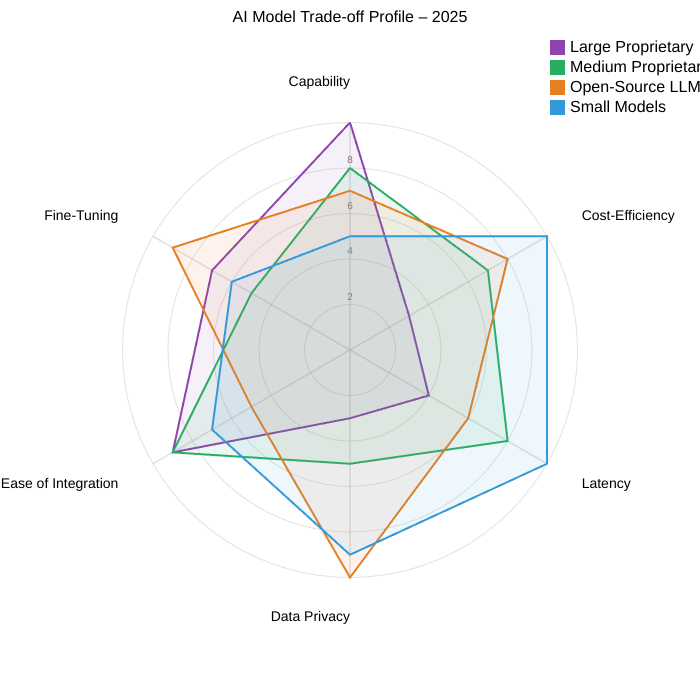
There's no single "best" AI model. The optimal choice depends heavily on your specific needs, involving trade-offs between:
- **Capability:** How well does it perform complex reasoning, creative tasks, or specialized instructions?
- **Cost:** How much does it cost per token (input and output)? This heavily impacts operational expenses ([OpenAI Pricing](https://openai.com/api/pricing), [Anthropic Pricing](https://www.anthropic.com/pricing)).
- **Speed (Latency):** How quickly does it generate responses? Crucial for interactive applications like chatbots ([OpenAI Latency](https://community.openai.com/t/gpt-3-5-and-gpt-4-api-response-time-measurements-fyi/237394), [Anthropic Latency](https://docs.anthropic.com/en/docs/test-and-evaluate/strengthen-guardrails/reduce-latency)).
- **Reliability & Consistency:** Does it follow instructions well? Is its output predictable?
- **Data Privacy:** Where is the model hosted? What are the provider's data usage policies? (Especially critical under Swiss FADP/GDPR) ([OpenAI Privacy](https://openai.com/policies/row-privacy-policy/), [Anthropic Privacy](https://privacy.anthropic.com/en/articles/10023548-how-long-do-you-store-personal-data)).
- **Fine-tuning Potential:** How easily can it be adapted to your specific domain or tasks?
Key Models & Their Business Use Cases (Early 2025 Snapshot)
*(Note: The AI landscape changes rapidly. This is a snapshot based on trends and models prominent around this time. Always verify current capabilities.)*
1. **Large Proprietary Models (e.g., OpenAI's GPT-4 family, Anthropic's Claude 3 Opus):** * **Pros:** Highest capability for complex reasoning, creativity, and nuanced tasks. Often lead in benchmark performance. Extensive APIs and tooling. * **Cons:** Highest cost per token ([OpenAI Pricing](https://openai.com/api/pricing), [Anthropic Pricing](https://www.anthropic.com/pricing)). Can have higher latency ([OpenAI Latency](https://community.openai.com/t/gpt-3-5-and-gpt-4-api-response-time-measurements-fyi/237394)). Data privacy policies require careful review ([OpenAI Privacy](https://openai.com/policies/row-privacy-policy/)). * **Best For:** Complex strategy development, high-quality content generation, sophisticated analysis, tasks requiring deep understanding. Often overkill for simpler automation or chatbot tasks. * **Fanktank Use:** We leverage these for complex [AI Strategy Consulting](/services/consulting) analysis and demanding [Custom AI Development](/services/custom-dev) tasks where peak performance is essential.
2. **Medium/Efficient Proprietary Models (e.g., OpenAI's GPT-4o / GPT-4o-mini, Anthropic's Claude 3 Sonnet/Haiku, Google's Gemini Pro variants):** * **Pros:** Excellent balance of capability, speed, and cost. Significantly cheaper than the top-tier models ([OpenAI Pricing](https://openai.com/api/pricing)). Often much faster ([Anthropic Latency](https://docs.anthropic.com/en/docs/test-and-evaluate/strengthen-guardrails/reduce-latency)). Still very capable for most business tasks. * **Cons:** Slightly less capable on the most complex reasoning tasks. Data privacy considerations still apply ([Anthropic Privacy](https://privacy.anthropic.com/en/articles/10023548-how-long-do-you-store-personal-data)). * **Best For:** Powering customer service chatbots, content summarization, standard document analysis, internal knowledge assistants (like RAG systems), general business automation. This category often hits the sweet spot for SMEs. * **Fanktank Use:** Ideal for our [Smart Knowledge Systems (RAG)](/services/knowledge-systems) and many [AI-Enhanced Website](/services/web-solutions) features due to their balance. Also used in custom solutions where extreme reasoning isn't the primary need.
3. **Leading Open Source Models (e.g., Meta's Llama 3 variants, Mistral Large/Medium/Small):** * **Pros:** Can be self-hosted (offering greater data control/privacy). No direct per-token cost (but hosting/operational costs apply). Highly performant ([Meta Llama 3](https://www.acorn.io/resources/learning-center/meta-llama-3/), [Mistral Performance](https://mistral.ai/news/mistral-large)). Strong community support. Excellent fine-tuning potential. * **Cons:** Requires technical expertise to deploy and manage effectively. Can be less user-friendly out-of-the-box. Responsible deployment (safety, ethics) rests more heavily on the implementer. * **Best For:** Businesses with technical teams prioritizing data sovereignty, cost predictability (for high volume), or needing deep customization via fine-tuning. Specialized internal tools. * **Fanktank Use:** We utilize open-source models in [Custom AI Development](/services/custom-dev) when clients require on-premise solutions, maximum data control, or highly specialized fine-tuning.
4. **Small Language Models (SLMs - e.g., Phi-3, Gemma variants):** * **Pros:** Very fast, low resource requirements (can potentially run on-device). Extremely cost-effective. Good for specific, narrow tasks. Inherently offer better privacy if run locally ([Microsoft Phi-3](https://azure.microsoft.com/en-us/blog/introducing-phi-3-redefining-whats-possible-with-slms/), [Google Gemma](https://ai.google.dev/gemma)). * **Cons:** Limited general reasoning capabilities compared to larger models. Best suited for well-defined tasks. * **Best For:** On-device AI features, simple text classification or summarization, powering specific features within larger applications where latency is critical. * **Fanktank Use:** Exploring their use in specific edge-case automation and within [AI-Enhanced Websites](/services/web-solutions) for quick, contained tasks.
Making the Right Choice for Your Swiss Business
- **Define the Task:** What *exactly* do you need the AI to do? Be specific.
- **Assess Requirements:** How critical are speed, cost, accuracy, and data privacy for this specific application?
- **Start Lean:** For many initial projects, a medium/efficient proprietary model (like GPT-4o-mini or Claude 3 Haiku) offers the best starting point due to its balance and ease of use via APIs.
- **Consider Open Source for Control:** If data privacy is paramount or you have the technical capability and need fine-tuning, explore leading open-source options.
- **Pilot and Evaluate:** Test your chosen model(s) on your specific task with real data. Measure performance against your goals. Don't rely solely on generic benchmarks.
Fanktank Can Help You Navigate
Choosing the right AI model is a critical part of a successful AI strategy. We bring Swiss precision to this process, helping you analyze the trade-offs and select the technology that best aligns with your business goals and budget.
**Unsure which AI model fits your needs? Let's analyze your specific use case together.**
[Book a Free AI Strategy Consultation](/contact)
References
- [OpenAI, 2024] ["API Pricing"](https://openai.com/api/pricing), OpenAI. *(Outlines token pricing for models like GPT-4 and GPT-4o-mini, including their capabilities and context window sizes.)*
- [Anthropic, 2024] ["Claude 3 Model Pricing"](https://www.anthropic.com/pricing), Anthropic. *(Details pricing and context length of Claude 3 Opus, Sonnet, and Haiku models.)*
- [OpenAI Community, 2024] ["GPT-3.5 and GPT-4 API Response Time Measurements"](https://community.openai.com/t/gpt-3-5-and-gpt-4-api-response-time-measurements-fyi/237394), OpenAI. *(User-shared benchmarks showing typical latency for GPT-3.5 and GPT-4 in production use.)*
- [Anthropic Docs, 2024] ["Reduce Latency"](https://docs.anthropic.com/en/docs/test-and-evaluate/strengthen-guardrails/reduce-latency), Anthropic. *(Best practices for minimizing latency with Claude models including prompt optimization and streaming use.)*
- [OpenAI, 2024] ["Privacy Policy"](https://openai.com/policies/row-privacy-policy/), OpenAI. *(Describes how OpenAI handles user data and compliance with regulations like GDPR.)*
- [Anthropic, 2024] ["How Long Do You Store Personal Data?"](https://privacy.anthropic.com/en/articles/10023548-how-long-do-you-store-personal-data), Anthropic. *(Explains Anthropic’s data retention practices and privacy guarantees for enterprise users.)*
- [Acorn Learning Center, 2024] ["Meta Llama 3 Overview"](https://www.acorn.io/resources/learning-center/meta-llama-3/), Acorn. *(Introduces the capabilities of Meta’s Llama 3 models and their improvements in instruction following.)*
- [Mistral AI, 2024] ["Mistral Large"](https://mistral.ai/news/mistral-large), Mistral. *(Announces Mistral Large with benchmark results that place it just behind GPT-4 in performance.)*
- [Microsoft Azure Blog, 2024] ["Introducing Phi-3"](https://azure.microsoft.com/en-us/blog/introducing-phi-3-redefining-whats-possible-with-slms/), Microsoft. *(Presents Phi-3 as a family of compact language models that punch above their size in reasoning and speed.)*
- [Google AI, 2024] ["Gemma Models"](https://ai.google.dev/gemma), Google. *(Details Gemma's design for local/on-device use, multilingual support, and lightweight performance.)*