Coding Agents Are the Preview of Agentic Work
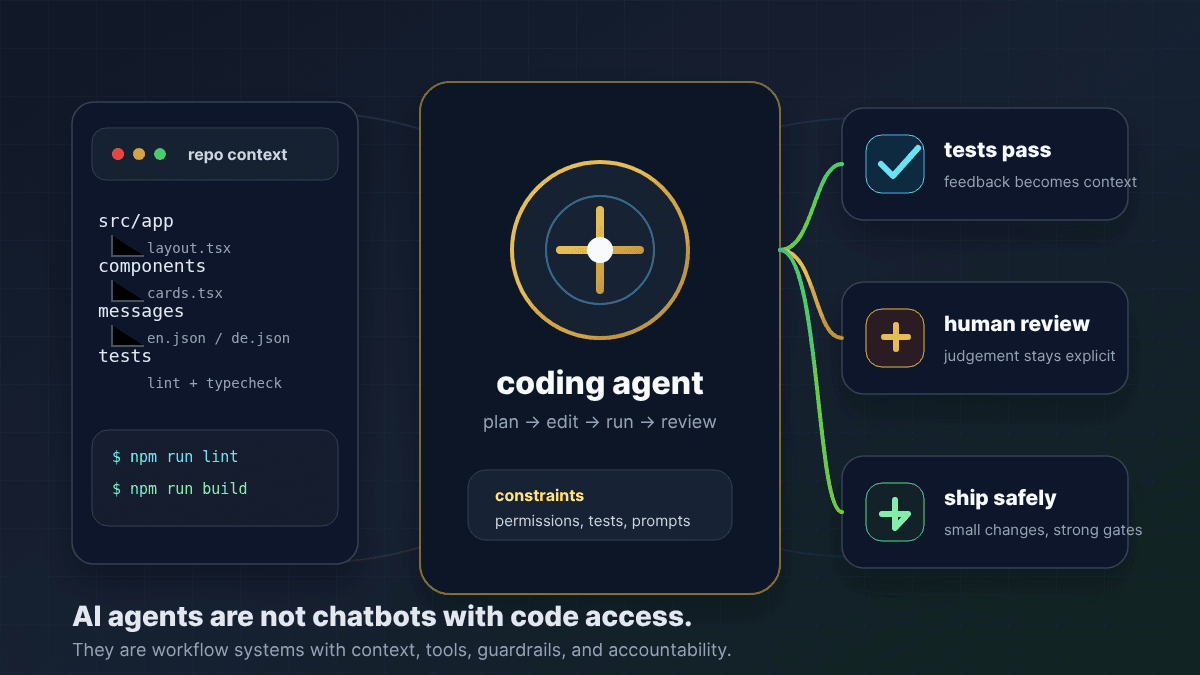
For years, most business AI was stuck in a chat window. You asked a question, the model answered, and the real work still happened somewhere else. That is changing. The clearest proof is not in a slide deck about "autonomous enterprises". It is in coding agents such as OpenAI Codex and Anthropic Claude Code.
These tools are important because they are not just better autocomplete. They read a codebase, edit files, run commands, respond to test output, prepare pull requests, and work across terminal, IDE, browser, and cloud environments. OpenAI describes Codex as a coding agent for building and shipping with AI, with multi-agent workflows, worktrees, Skills, and Automations. Anthropic describes Claude Code as an agentic coding tool that reads a codebase, edits files, runs commands, and integrates with development tools.
That matters beyond software teams. Coding agents are the first widely visible version of a more general pattern: AI systems that do useful work because they have the right context, the right tools, clear boundaries, and feedback loops.
Why coding came first
Software is unusually agent-friendly.
A repository gives the agent a structured working memory. Source files, tests, package scripts, issue descriptions, commit history, and documentation all live in a format a language model can inspect. The work is also naturally incremental: a feature becomes a diff, a bug fix becomes a patch, a refactor becomes a sequence of edits.
Most importantly, software has built-in feedback. Type checkers, linters, tests, build logs, code review, and runtime errors tell the agent whether it is moving in the right direction. A human can still decide whether the change is desirable, but the agent does not have to operate blindly.
This is why coding agents feel more real than many generic AI agents. They are surrounded by instrumentation.
The real lesson is architecture, not coding
The mistake is to look at Codex or Claude Code and conclude: "AI can now write code." That is true, but it is not the interesting part.
The interesting part is the operating model.
- The agent receives a goal.
- It inspects the relevant context.
- It proposes or executes a plan.
- It uses tools with scoped permissions.
- It observes outputs from those tools.
- It adjusts the work.
- It produces an auditable artifact for review.
That loop is the bridge from coding agents to serious business agents:
That pattern can apply to many business workflows. A finance agent can reconcile invoices if it has access to the ERP, matching rules, approval limits, and exception handling. A sales operations agent can enrich leads if it has CRM access, data quality checks, and human review for high-value accounts. A legal intake agent can draft first-pass summaries if it has templates, document access, confidentiality boundaries, and sign-off gates.
The agent is not valuable because it sounds intelligent. It is valuable because it is wired into a system where action, feedback, and accountability are designed.
What Codex and Claude Code get right
Modern coding agents show several design choices that business AI should copy.
First, they operate in a real workspace. They are not answering from memory alone. They inspect the actual repository and can modify the files that matter.
Second, they use tools. Shell commands, patching, search, file reads, browser-based documentation, and integrations turn the model into part of a workflow rather than a detached advisor.
Third, they respect boundaries. The useful versions of these systems run with permissions, sandboxing, approval rules, branch isolation, and review gates. This is not bureaucracy. It is what makes agentic work safe enough to use repeatedly.
Fourth, they use reusable instructions. Files such as `AGENTS.md`, `CLAUDE.md`, Cursor rules, Skills, hooks, and project commands give the agent local operating knowledge. The system improves when its rules are explicit: how to run tests, which package manager to use, what style to preserve, what not to touch.
Fifth, they make review natural. A diff, a test log, and a pull request are excellent review surfaces. Business agents need equivalent artifacts: change summaries, source citations, approval queues, audit logs, and rollback plans.
The limits are just as important
Coding agents are powerful, but they also reveal the hard parts.
They can make wrong assumptions. They can overcomplicate a simple change. They can edit adjacent code they did not need to touch. They can pass the narrow check while missing the business intent. They can become expensive if they loop without good success criteria.
These are not reasons to ignore agents. They are reasons to design them properly.
The best agent setups are not "give the AI full access and hope". They are closer to senior delegation:
- Give a clear goal and definition of done.
- Provide the context the agent should trust.
- Limit tools to what the task needs.
- Prefer small, reviewable changes.
- Run objective checks automatically.
- Keep humans in the loop for judgement, risk, and taste.
This is why agent configuration matters. Andrej Karpathy's recent criticism of coding agents is essentially about operational discipline: agents should surface confusion, avoid hidden assumptions, keep changes small, and verify against concrete goals. That is not a coding-only lesson. It is how every production agent should be managed.
What this means for businesses
Most companies should not start by asking, "Can we build an autonomous AI employee?"
They should start with a narrower question:
**Where do we already have structured context, repeatable tool actions, and clear review criteria?**
Good first candidates usually have these properties:
- The input is already digital: tickets, emails, PDFs, CRM records, spreadsheets, database rows.
- The workflow has recurring steps.
- The output can be reviewed before it creates risk.
- Mistakes are detectable.
- A human currently spends time moving information between systems.
That is why agentic systems often begin in places like customer support triage, document intake, internal reporting, sales operations, compliance preparation, engineering maintenance, or knowledge retrieval. The task does not need to be glamorous. It needs to be instrumented.
The practical angle for customers
The takeaway is not that every company suddenly needs a coding agent. Coding agents are useful as a preview because they show the pattern under unusually good conditions: structured context, tool access, objective checks, and reviewable outputs.
For a business, the right angle is not "add an agent everywhere". It is to identify the workflows where an agent can safely become part of the operating system: reading the right sources, preparing or taking narrow actions, showing its evidence, and escalating uncertainty.
That usually leads to three useful starting points:
- Knowledge work where answers need citations and source traceability.
- Operational workflows where information moves between systems and humans review final decisions.
- Product features where AI can act inside an existing user journey with permissions, logs, and fallbacks.
This keeps the scope broad without becoming vague. The project is not framed around a buzzword; it is framed around a business workflow that can be made faster, clearer, or more reliable.
How to evaluate an agent opportunity
Before building an agent, ask these questions:
- What work artifact should the agent produce?
- Which sources of truth may it read?
- Which tools may it use?
- What actions require approval?
- How will we know the output is correct enough?
- What should happen when confidence is low?
- What should be logged for audit and improvement?
For example, a support-intake workflow might be scored like this. The numbers are not a universal benchmark; they are a quick way to make the tradeoffs visible before building.
If those questions feel hard to answer, the project is not ready for a full agent yet. Start with a smaller assistant, a retrieval system, or a workflow automation. If the answers are clear, an agent can be a serious productivity system rather than a demo.
The near future
Coding agents are moving quickly because they sit in an environment built for iteration. They can branch, patch, test, review, and revert. Other business domains will follow as their workflows become more structured and tool-accessible.
The winners will not be the companies that buy the most agent subscriptions. The winners will be the companies that turn their internal work into agent-ready systems: good data access, clear permissions, explicit processes, measurable outputs, and review loops.
That is the real shift. AI agents are not magic workers. They are workflow participants. When the workflow is designed well, they become useful very quickly.
[Explore Custom AI Systems](/services/custom-dev) | [View Workflow+ Architect](/projects/workflow-plus-architect) | [Book a consultation](/contact)
References
- [OpenAI, 2026] ["Codex"](https://openai.com/codex/), OpenAI. *(Product overview describing Codex as a coding agent for building and shipping with AI.)*
- [OpenAI Developers, 2026] ["Codex docs"](https://developers.openai.com/codex/cloud), OpenAI. *(Documentation for Codex surfaces, workflows, subagents, skills, sandboxing, and configuration.)*
- [OpenAI, 2025] ["Introducing the Codex app"](https://openai.com/index/introducing-the-codex-app/), OpenAI. *(Announcement of the Codex cloud software engineering agent.)*
- [Anthropic, 2026] ["Claude Code overview"](https://code.claude.com/docs/en/overview), Anthropic. *(Claude Code documentation describing terminal, IDE, desktop, and browser usage.)*
- [Anthropic, 2026] ["Create custom subagents"](https://code.claude.com/docs/en/sub-agents), Anthropic. *(Documentation on specialized subagents, context management, tool access, and delegation.)*
- [Anthropic, 2026] ["Hooks reference"](https://code.claude.com/docs/en/hooks), Anthropic. *(Reference for configuring command hooks around Claude Code events.)*