The Universal Connector for AI: How MCP Transforms Business Integration
Every AI implementation eventually hits the same wall: data access. Your AI assistant can analyze text brilliantly, but it can't read your latest sales reports. It can generate insights, but it can't access your CRM data. It can draft responses, but it can't check your calendar for availability.
This isn't a limitation of AI models themselves—it's an integration problem. Connecting AI systems to business data traditionally requires custom development for each combination of AI tool and data source. For a company with 5 AI tools and 10 business systems, that's potentially 50 different integrations to build and maintain.
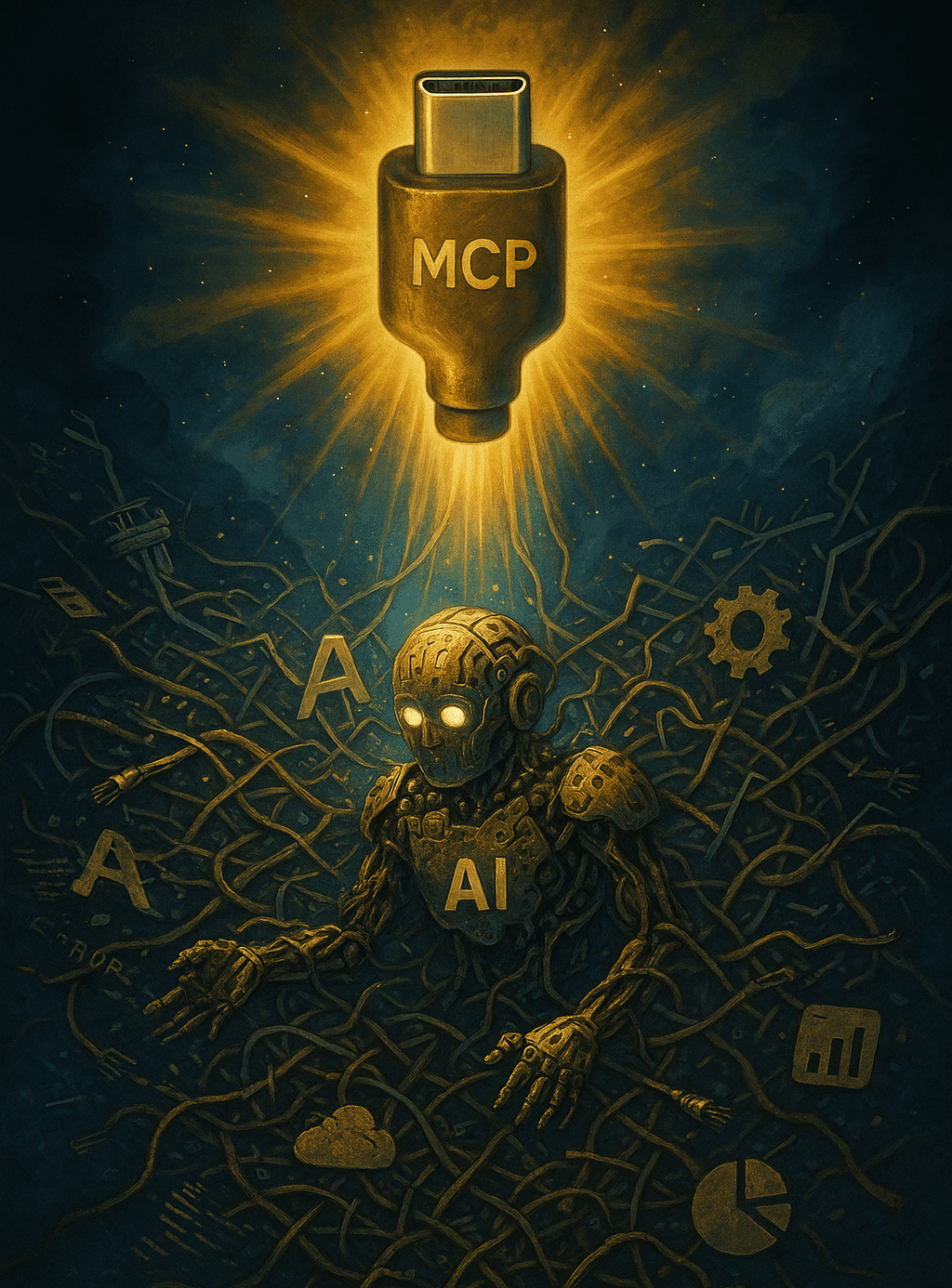
The **Model Context Protocol (MCP)**, introduced by Anthropic in November 2024, offers a different approach: a standardized way for AI systems to connect with external data sources and tools. Rather than building point-to-point integrations, MCP acts as a universal interface—like USB-C for AI applications.
The Integration Challenge
The complexity of AI integration isn't just theoretical. Companies regularly report that data preparation and integration work consumes significant portions of their AI project timelines, with data preparation alone accounting for up to 80% of project time and 15-25% of costs.
This complexity stems from what researchers call the "M×N problem": connecting M AI applications to N data sources requires building M×N integrations...
For Swiss businesses, this challenge is compounded by regulatory requirements. FADP compliance means careful data handling, audit trails, and often keeping data within Swiss borders—adding another layer of complexity to each integration.
Understanding MCP
MCP transforms the M×N problem into an M+N solution. Instead of building integrations between every AI tool and every data source, you build once per system: M connections from AI tools to MCP, and N connections from MCP to data sources.
The protocol uses a client-server architecture inspired by the Language Server Protocol (LSP), which successfully standardized how programming tools interact with different languages. MCP applies similar principles to AI-data connections.
Core Components
MCP organizes AI-system interactions into three categories:
**Tools**: Actions the AI can perform, like querying a database or sending an email. The AI decides when to use these based on user requests.
**Resources**: Information the AI can access, such as documents or data feeds. These provide context without side effects.
**Prompts**: Pre-configured interaction patterns that help users leverage tools and resources effectively.
Real-World Adoption
MCP adoption has accelerated rapidly since its introduction. OpenAI integrated MCP across its platform in March 2025, followed by Google's adoption in April. Microsoft added MCP support to Copilot Studio, citing the need for standardized AI-data connections.
Early adopters provide concrete examples of MCP's impact:
- **Block** uses MCP to connect internal AI assistants to proprietary documents and CRM systems, reducing integration development time significantly
- **Development tool companies** like Zed, Replit, and Sourcegraph leverage MCP to give coding assistants access to real-time code context
- **Healthcare organizations** are experimenting with MCP for HIPAA-compliant AI access to patient records
The ecosystem is growing rapidly. As of May 2025, over 5,000 MCP servers are publicly available, covering everything from Google Drive and Slack to specialized databases and custom enterprise systems.
Business Impact
For businesses evaluating AI strategies, MCP offers several concrete advantages:
**Reduced Integration Costs**: Instead of building custom integrations for each AI tool, businesses can leverage existing MCP servers or build once per system. Early adopters report 50-70% reductions in integration development time.
**Future-Proofing**: New AI tools that support MCP can immediately access all connected data sources without additional integration work.
**Standardized Security**: MCP provides consistent authentication, authorization, and logging across all AI-data interactions, simplifying compliance and audit requirements.
**Vendor Independence**: The open standard means businesses aren't locked into specific AI providers or forced to rebuild integrations when switching tools.
Security Considerations
MCP's power to connect AI systems broadly also introduces security considerations that businesses must address.
Security researchers have identified several risk areas:
**Permission Scope**: MCP servers often request broad access to services. Organizations should implement least-privilege principles, granting only necessary permissions.
**Supply Chain Risks**: Third-party MCP servers could potentially contain malicious code. Verification and vetting processes are essential.
**Prompt Injection**: Attackers might craft inputs that manipulate AI behavior through MCP interactions. Input validation and monitoring help mitigate these risks.
**Data Aggregation**: Connecting multiple systems through MCP creates new data correlation possibilities. Privacy impact assessments should consider these broader access patterns.
For Swiss businesses, MCP's permission-based architecture aligns well with FADP requirements for data minimization and purpose limitation. The protocol's local-first design also supports data sovereignty requirements.
Implementation Approach
Successful MCP adoption requires a structured approach that balances capability with security and compliance needs.
Phase 1: Assessment and Planning
Start by cataloging existing systems and identifying high-value, low-risk use cases. Document processing, calendar integration, and read-only database access often provide good starting points.
Evaluate existing MCP servers for your systems. Anthropic provides reference implementations for common enterprise tools like Google Drive, Slack, GitHub, and PostgreSQL.
Phase 2: Pilot Implementation
Begin with local experimentation using Claude Desktop, which supports MCP out of the box. This allows teams to experience MCP capabilities without enterprise-wide deployment.
Connect 2-3 non-sensitive systems to build familiarity with configuration, security models, and user workflows.
Phase 3: Enterprise Deployment
For organization-wide rollout, implement enterprise-grade security controls: centralized authentication, audit logging, and permission management.
Develop custom MCP servers for proprietary systems that lack existing integrations. The MCP SDK supports both Python and TypeScript development.
The Swiss Context
Swiss businesses have particular advantages in MCP adoption. The country's focus on precision engineering aligns well with MCP's standardized approach. Strong data protection regulations, while adding complexity, also drive demand for the kind of structured, auditable AI-data connections that MCP enables.
Local expertise is developing rapidly. Swiss technical universities are incorporating MCP concepts into AI curricula, and regional meetups focus on practical implementation challenges.
The regulatory environment also presents opportunities. As other regions implement their own AI governance frameworks, Swiss businesses with mature, compliant AI-data integration practices may find export opportunities for their expertise.
Practical Considerations
While MCP solves important problems, realistic implementation requires acknowledging current limitations:
**Maturity**: As a protocol introduced in late 2024, MCP is still evolving. Security frameworks and best practices are being developed based on real-world usage.
**Complexity**: Despite simplifying some aspects of AI integration, MCP still requires technical expertise to implement securely and effectively.
**Performance**: Adding a protocol layer introduces some overhead. For high-frequency or latency-sensitive applications, direct integrations might still be preferable.
**Ecosystem Gaps**: While growing rapidly, MCP server coverage isn't universal. Some specialized or legacy systems may require custom development.
Looking Forward
MCP represents a shift toward standardized AI-system integration that mirrors successful patterns in other technology areas. Just as protocols like HTTP standardized web communication and SMTP standardized email, MCP could establish common patterns for AI-data connections.
The protocol's open nature encourages broad adoption and community development. Unlike proprietary integration platforms, businesses can implement MCP without vendor lock-in or licensing dependencies.
For forward-looking organizations, early MCP adoption offers advantages in AI capability development, integration efficiency, and regulatory compliance. However, success requires treating MCP as part of a broader AI strategy, not a solution in isolation.
That broader strategy increasingly includes agents that can use tools inside controlled workflows. For a concrete example of that operating model, see [Coding Agents Are the Preview of Agentic Work](/blog/coding-agents-preview-agentic-work).
Making the Decision
MCP isn't appropriate for every AI use case or every organization. The protocol adds most value when:
- Connecting AI to multiple, diverse data sources
- Building for long-term AI capability expansion
- Operating under strict compliance requirements
- Seeking vendor independence in AI tooling
Organizations with single-purpose AI applications or simple data requirements might find direct integrations more straightforward.
Getting Started
For Swiss businesses ready to explore MCP, the path forward involves:
- **Education**: Understanding MCP concepts and security implications
- **Assessment**: Evaluating current AI and data infrastructure
- **Pilot**: Small-scale experimentation with existing MCP servers
- **Strategy**: Developing comprehensive integration and security plans
The technology is mature enough for serious evaluation, but early enough that careful implementation can provide competitive advantages.
MCP represents a pragmatic solution to a real problem in AI adoption. By standardizing AI-data connections, it removes a significant barrier to AI capability development while providing the security and compliance frameworks that enterprise adoption requires.
For businesses serious about AI integration, MCP deserves consideration not as a magic solution, but as a useful tool for building more capable, maintainable, and secure AI systems.
**Ready to explore how MCP could fit your AI strategy? Let's discuss your specific integration challenges and whether a standardized approach makes sense for your organization.**
[Explore AI Integration Strategy](/services/consulting) | [Discuss Your AI Roadmap](/contact)
References
- [Anthropic, 2024] ["Introducing the Model Context Protocol"](https://www.anthropic.com/news/model-context-protocol), Anthropic. *(Official announcement of MCP with technical architecture and early adoption examples.)*
- [Model Context Protocol, 2025] ["MCP Specification"](https://modelcontextprotocol.io/specification/2025-03-26), MCP.io. *(Complete technical specification including security considerations and implementation guidelines.)*
- [Wikipedia, 2025] ["Model Context Protocol"](https://en.wikipedia.org/wiki/Model_Context_Protocol), Wikipedia. *(Overview of adoption timeline, use cases, and ecosystem growth.)*
- [Writer Engineering, 2025] ["Model Context Protocol (MCP) Security Considerations"](https://writer.com/engineering/mcp-security-considerations/), Writer. *(Analysis of security risks and enterprise implementation best practices.)*
- [Pillar Security, 2025] ["The Security Risks of Model Context Protocol (MCP)"](https://www.pillar.security/blog/the-security-risks-of-model-context-protocol-mcp), Pillar Security. *(Detailed security analysis including prompt injection and supply chain risks.)*
- [Cato Networks, 2025] ["Exploiting Model Context Protocol (MCP)"](https://www.catonetworks.com/blog/cato-ctrl-exploiting-model-context-protocol-mcp/), Cato Networks. *(Security research including proof-of-concept attacks and mitigation strategies.)*