AI Agents: Are They *Really* the Next Big Thing for Your Business?
We've become accustomed to interacting with AI through chatbots and content generators powered by sophisticated Large Language Models (LLMs). These tools understand and create language incredibly well. But what's next? Increasingly, the conversation is shifting towards **AI Agents** – systems designed not just to *talk*, but to *act*.
The hype suggests agents will soon manage our schedules, run our businesses, and operate with full autonomy. While that sci-fi vision is still distant, the underlying technology represents a significant leap forward with tangible implications for businesses today and in the near future.
At Fanktank, we believe in cutting through the hype to focus on practical value. So, what are AI agents, why are they considered the "next big thing," and how should Swiss businesses realistically approach them?
What Makes an AI Agent Different?
Think beyond a simple chatbot. An AI agent is typically defined by its ability to:
- **Pursue Goals:** It's given an objective (e.g., "Summarize Q1 sales reports and draft an email to the leadership team").
- **Plan:** It can break down that complex goal into a sequence of smaller, manageable steps.
- **Use Tools:** Crucially, it can interact with other software, APIs, databases, search engines, or even specialized AI models (like using a [RAG system](/blog/unlock-your-company-knowledge-rag) to find information).
- **Maintain Memory:** It remembers context from previous steps and interactions to inform future actions.
- **Reason & Decide:** It makes choices about which step to take next or which tool to use based on its goal and the information available.
- **Act (Autonomously, within limits):** It executes the planned steps by using its tools, potentially interacting with digital environments.
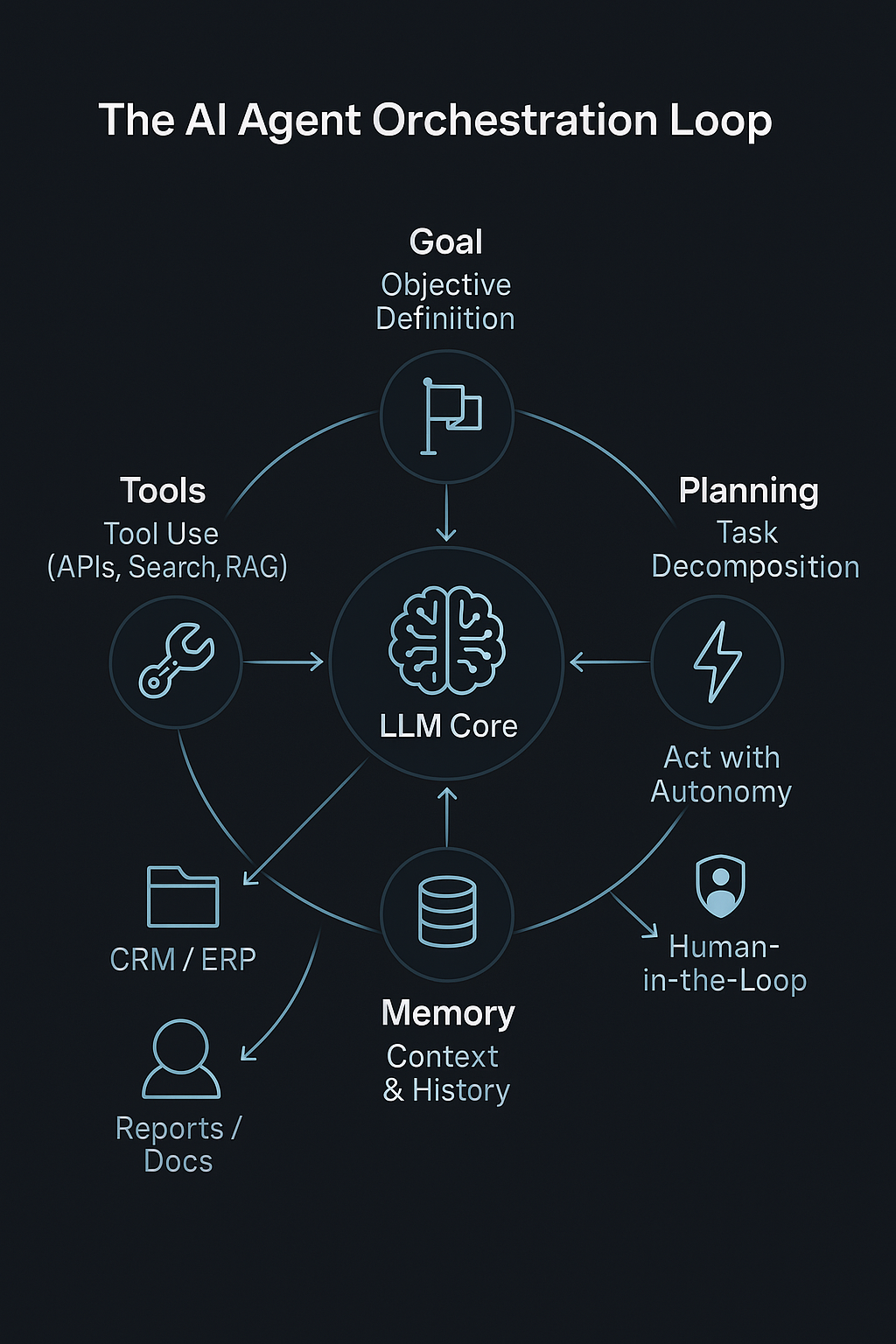
Essentially, agents add a layer of *action and orchestration* on top of the language capabilities of LLMs.
Why the Buzz Now?
The recent explosion in LLM capabilities (like GPT-4, Claude 3, Llama 3) provides the powerful "reasoning engine" needed for agents to function more effectively. These models can understand complex instructions, formulate plans, and interpret tool outputs, a trend underscored by major tech firms like Google and OpenAI investing heavily in agent frameworks ([McKinsey, 2024](https://www.mckinsey.com/capabilities/mckinsey-digital/our-insights/why-agents-are-the-next-frontier-of-generative-ai)). Frameworks like LangChain and LlamaIndex are also making it more feasible (though still complex) to build the scaffolding required for agentic behaviour.
Transforming Workflows: Potential Near-Term Use Cases
While fully autonomous general agents are still largely experimental, domain-specific or workflow-specific agents offer compelling near-term potential. For instance, companies like ServiceNow have deployed agents that resolve customer support cases 52% faster by automating tasks like drafting responses ([Business Insider, 2025](https://www.businessinsider.com/startups-ai-agents-raising-venture-funding-2025-1)). Here are some practical examples:
- **Hyper-Automation of Complex Processes:** Imagine an agent handling new client onboarding: receiving a signed contract, extracting key data, creating accounts in CRM and project tools, scheduling a kickoff call based on calendar availability, and drafting a welcome email – only flagging exceptions for human review.
- **Proactive Customer Support Resolution:** An agent that doesn't just answer FAQs but accesses order history, checks shipping status via carrier APIs, analyzes sentiment, and proactively offers solutions (like initiating a return or offering a discount) based on defined business rules.
- **Intelligent Research & Reporting:** An agent tasked with monitoring industry news, competitor announcements, and internal sales data, then autonomously compiling a summarized weekly intelligence report with key findings and trends.
- **Smart Personal/Team Assistants:** Agents that go beyond simple reminders, perhaps managing complex scheduling across teams, filtering and summarizing email based on priority, or drafting meeting minutes by listening to recordings.
The Crucial Reality Check: Challenges Remain
Despite the potential, building and deploying *reliable* and *safe* AI agents for business is challenging:
- **Reliability & Predictability:** Agents operating over multiple steps with various tools can fail in unexpected ways. Research shows that while agents are improving at long tasks, they’re not yet reliable, though successful runs can cost less than 10% of a human engineer’s effort ([arXiv, 2024](https://arxiv.org/abs/2407.01502)). How do you prevent an agent from booking 100 flights instead of 1?
- **Security Risks:** Giving an AI agent access to multiple systems, APIs, and sensitive data significantly increases the security footprint, a concern echoed in enterprise modernization efforts ([BCG, 2024](https://www.bcg.com/capabilities/artificial-intelligence/ai-agents)). Robust authentication, authorization, and auditing are critical.
- **Control & Oversight:** Defining clear boundaries and ensuring human oversight mechanisms are in place is essential to prevent costly mistakes or unintended consequences. How much autonomy is *too* much?
- **Cost:** Complex agentic workflows can consume significant computational resources (LLM tokens, API calls), leading to high operational costs if not optimized carefully. Studies suggest optimizing for both cost and accuracy could mitigate this ([arXiv, 2024](https://arxiv.org/abs/2407.01502)).
- **Development Complexity:** Architecting, building, testing, and maintaining robust agents requires significant expertise in AI, software engineering, and the specific business domain, a point emphasized by industry analyses ([Insight Partners, 2025](https://www.insightpartners.com/ideas/state-of-the-ai-agent-ecosystem-use-cases-and-learnings-for-technology-builders-and-buyers/)). This is far beyond setting up a simple chatbot.
Building Agents the Fanktank Way: Strategy and Precision
The allure of automation is strong, but diving headfirst into agent development without a clear strategy is risky. At Fanktank, we advocate a measured approach:
- **Strategic Assessment:** Is an agent truly the right solution? What specific, high-value problem will it solve? Could simpler automation or a well-designed RAG system achieve 80% of the benefit with less risk? Our [AI Strategy Consulting](/services/consulting) helps answer these questions first.
- **Focus on Reliability:** We prioritize building agents with clear goals, limited scope, robust error handling, and well-defined tool interactions.
- **Security by Design:** Security considerations are integrated from the start, not bolted on later.
- **Custom Development:** For reliable business agents, off-the-shelf agent platforms often lack the necessary customization, control, and integration capabilities. Our [Custom AI Development](/services/custom-dev) service focuses on building these tailored, robust solutions.
- **Human-in-the-Loop:** We often design agentic workflows with built-in checkpoints for human review and approval, ensuring control and trust.
Preparing for the Agentic Future
AI Agents represent a compelling evolution, promising deeper integration of AI into the fabric of business operations. While challenges remain, the potential for transforming complex workflows is undeniable. The key is to approach this next wave with clear strategic thinking, a focus on practical value, and a commitment to building reliable, secure systems.
For a more recent, concrete example of this pattern in software work, read [Coding Agents Are the Preview of Agentic Work](/blog/coding-agents-preview-agentic-work).
**Is your business ready to explore the potential of AI agents? Let Fanktank help you navigate the hype, understand the realities, and strategize how targeted agentic solutions might fit your future.**
[Discuss Your AI Agent Strategy](/contact)
References
- [McKinsey, 2024] ["Why AI agents are the next frontier of generative AI"](https://www.mckinsey.com/capabilities/mckinsey-digital/our-insights/why-agents-are-the-next-frontier-of-generative-ai), McKinsey & Company. *(Published July 24, 2024; confirms the shift from LLMs as knowledge tools to agents executing multistep workflows.)*
- [Business Insider, 2025] ["Startups Exploring 'AI Agents' Are All the Rage in Silicon Valley"](https://www.businessinsider.com/startups-ai-agents-raising-venture-funding-2025-1), Business Insider. *(Published January 22, 2025; covers early commercial use of AI agents and automation gains.)*
- [arXiv, 2024] ["AI Agents That Matter"](https://arxiv.org/abs/2407.01502), arXiv preprint 2407.01502. *(Published July 1, 2024; discusses performance and cost-effectiveness of agents in complex tasks.)*
- [BCG, 2024] ["AI Agents: What They Are and Their Business Impact"](https://www.bcg.com/capabilities/artificial-intelligence/ai-agents), Boston Consulting Group. *(Published 2024; addresses security risks, autonomy, and oversight in enterprise agent deployments.)*
- [Insight Partners, 2025] ["The State of the AI Agent Ecosystem: The Tech, Use Cases, and Learnings for Technology Builders and Buyers"](https://www.insightpartners.com/ideas/state-of-the-ai-agent-ecosystem-use-cases-and-learnings-for-technology-builders-and-buyers/), Insight Partners. *(Published January 18, 2025; explores development complexity and industry trends.)*