The Next 3 Years in Business AI: From Smart Assistants to Automated Workflows
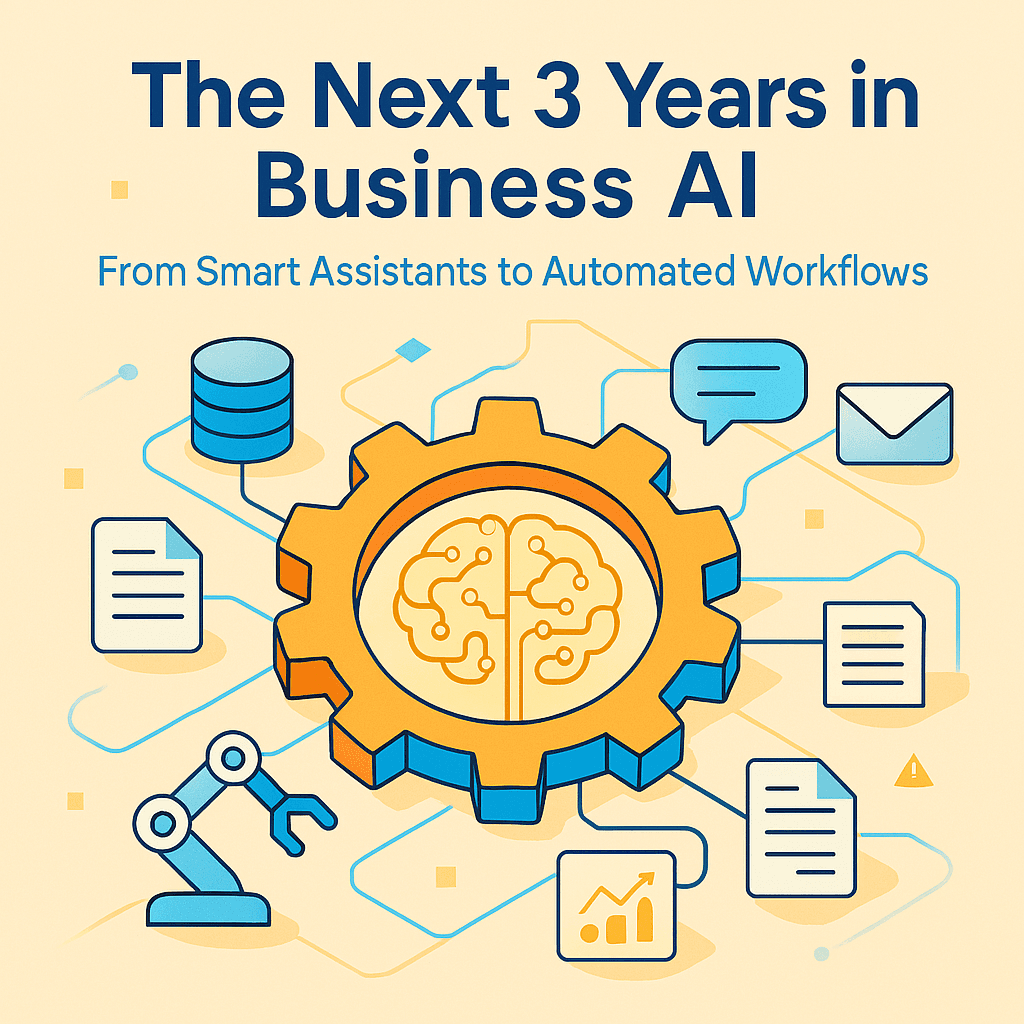
Predicting the long-term future of Artificial Intelligence is notoriously difficult. However, by looking at current capabilities, development trajectories, and persistent business needs, we can anticipate some tangible shifts likely to impact businesses, particularly SMEs, over the next 1–3 years.
At Fanktank, we focus on practical applications, not science fiction. While headlines might scream about Artificial General Intelligence (AGI), the more immediate evolution lies in AI becoming deeply embedded within specific business workflows, moving from standalone tools to integrated, increasingly autonomous systems.
Here are three key trends we see shaping the near future of business AI:
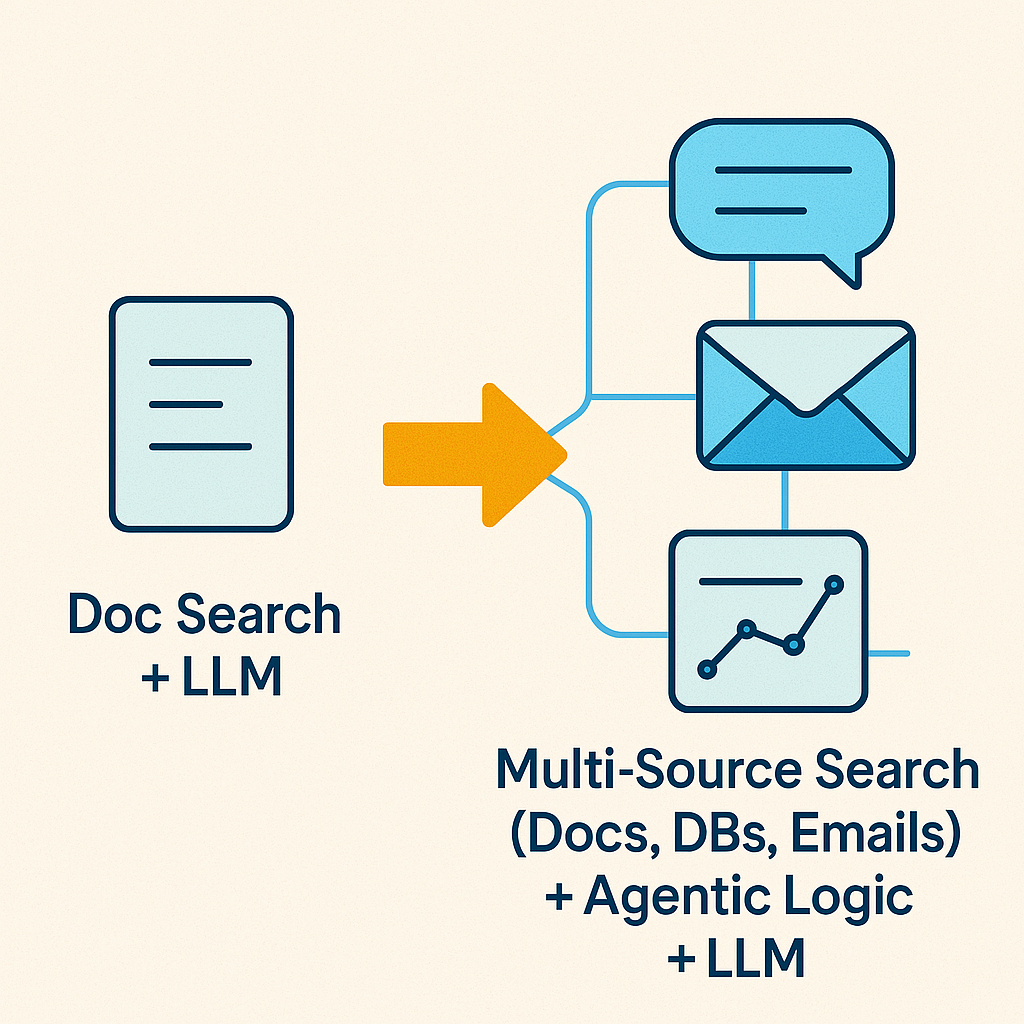
1. Sophisticated RAG 2.0: Beyond Simple Q&A
Retrieval-Augmented Generation (RAG) is already transforming knowledge access ([see our intro here](/blog/unlock-your-company-knowledge-rag)). The next evolution will involve:
- **Multi-Source Integration:** RAG systems will seamlessly query not just documents, but also structured databases (SQL, CRMs), email archives, and real-time data streams, providing holistic answers. Imagine asking, "What was our revenue from Project X last quarter, and summarize the key client feedback from emails?" ([K2View, 2024](https://www.k2view.com/what-is-retrieval-augmented-generation), [Elastic, 2024](https://www.elastic.co/what-is/retrieval-augmented-generation))
- **Agentic RAG:** RAG systems will become more proactive. They might monitor data sources and alert users to relevant new information, automatically summarize lengthy reports based on user interests, or even draft initial responses to queries based on retrieved knowledge ([AWS, 2024](https://aws.amazon.com/what-is/retrieval-augmented-generation/)).
- **Improved Context Understanding:** Techniques like graph-based RAG and hybrid search (combining semantic and keyword methods) will lead to even more accurate and nuanced retrieval, better handling complex queries and understanding relationships within the data. (We explore some of these advanced techniques in our [Custom AI work](/services/custom-dev)).
**Impact:** Deeper insights, more proactive knowledge discovery, and more efficient information workflows.
2. Hyper-Automation: AI Orchestrating Complex Workflows
Current AI often automates discrete tasks. The next step is AI orchestrating multi-step, complex business processes involving decision-making, interaction with multiple systems, and human oversight where needed.
- **AI as the Workflow Engine:** Instead of just extracting data from an invoice, AI could validate it against purchase orders, identify discrepancies, route it for approval based on complex rules, trigger payments in the accounting system, and archive the documents – potentially only requiring human intervention for exceptions ([Automation Anywhere, 2021](https://www.automationanywhere.com/rpa/hyperautomation)).
- **Integration with Existing Tools:** Expect tighter integration between AI platforms (like LangChain agents) and standard business software (CRMs, ERPs, project management tools) via robust APIs ([Oracle, 2023](https://www.oracle.com/cloud/hyperautomation/)).
- **Human-in-the-Loop Refinement:** Workflows will be designed for collaboration, allowing humans to easily review AI decisions, provide feedback, and handle edge cases the AI isn't confident about ([SAP, 2023](https://www.sap.com/products/technology-platform/process-automation/what-is-hyperautomation.html)).
**Impact:** Significant efficiency gains in back-office operations, supply chain management, customer onboarding, and more. Requires careful process design and reliable [Custom AI solutions](/services/custom-dev).
3. Truly Useful AI Agents (for Specific Domains)
Forget the idea of a single, all-knowing AI assistant running your company tomorrow. Instead, expect the rise of highly capable AI agents specialized for specific business functions or domains.
- **The Proactive Sales Assistant:** An agent that monitors CRM activity, suggests follow-ups, drafts personalized outreach emails based on prospect history and company knowledge, and summarizes sales call transcripts with action items ([Unite.AI, 2025](https://www.unite.ai/best-ai-agents-for-business-automation/)).
- **The Intelligent Project Management Bot:** An agent integrated with tools like Jira or Asana that can analyze project progress, flag potential risks based on communication patterns or task delays, answer team questions about project specs (using RAG), and draft status reports ([AI21 Labs, 2025](https://www.ai21.com/blog/ai-agent-frameworks/)).
- **The Domain-Specific Research Analyst:** An agent trained (or fine-tuned) on a specific industry's literature and data, capable of performing complex research queries, summarizing findings, and identifying trends far faster than manual methods ([Oracle Australia, 2025](https://www.oracle.com/au/artificial-intelligence/ai-agents/)).
**Impact:** Empowering employees by offloading complex but routine cognitive tasks, enabling them to focus on higher-level strategy and decision-making. Requires robust grounding (like RAG) and careful goal-setting.
Preparing for the Near Future
These trends aren't decades away; the building blocks are here now. Businesses, especially agile SMEs in Switzerland, can prepare by:
- **Digitizing & Organizing Information:** Ensure your key knowledge is in machine-readable formats suitable for RAG.
- **Mapping Key Workflows:** Identify complex, multi-step processes ripe for AI-driven automation.
- **Starting with Pilot Projects:** Experiment with current RAG or automation tools to build internal expertise and understanding. Explore an [AI Strategy session](/services/consulting) to identify the best starting points.
- **Focusing on Integration:** Plan how AI tools will connect with your existing software stack.
The next few years promise AI moving from novelty tools to integral parts of the business engine. Fanktank is here to help you architect and implement these practical, high-impact solutions.
**Want to explore how these near-future AI trends could specifically benefit your business operations?**
[Let's Strategize Your AI Future](/contact)
References
- [AWS, 2024] ["What is RAG? - Retrieval-Augmented Generation AI Explained"](https://aws.amazon.com/what-is/retrieval-augmented-generation/), AWS. *(Describes how RAG systems augment LLMs with up-to-date, external sources to improve response accuracy.)*
- [K2View, 2024] ["What is Retrieval-Augmented Generation (RAG)?"](https://www.k2view.com/what-is-retrieval-augmented-generation), K2View. *(Covers multi-source integration and real-time knowledge synthesis in advanced RAG systems.)*
- [Elastic, 2024] ["What is Retrieval Augmented Generation (RAG)?"](https://www.elastic.co/what-is/retrieval-augmented-generation), Elastic. *(Explains how RAG combines private and public data to produce grounded AI outputs.)*
- [Automation Anywhere, 2021] ["What is Hyperautomation?"](https://www.automationanywhere.com/rpa/hyperautomation), Automation Anywhere. *(Defines hyperautomation as the orchestration of multiple tools and technologies to automate entire workflows.)*
- [Oracle, 2023] ["What Is Hyperautomation?"](https://www.oracle.com/cloud/hyperautomation/), Oracle. *(Describes how hyperautomation connects AI and business software for streamlined digital processes.)*
- [SAP, 2023] ["What is hyperautomation?"](https://www.sap.com/products/technology-platform/process-automation/what-is-hyperautomation.html), SAP. *(Outlines the benefits and design considerations for enterprise-wide automation.)*
- [Unite.AI, 2025] ["10 Best AI Agents for Business Automation"](https://www.unite.ai/best-ai-agents-for-business-automation/), Unite.AI. *(Highlights real-world use cases of AI agents across sales, HR, and operations.)*
- [AI21 Labs, 2025] ["12 AI Agent Frameworks for Enterprises"](https://www.ai21.com/blog/ai-agent-frameworks/), AI21 Labs. *(Compares frameworks that support intelligent, multi-step decision-making agents.)*
- [Oracle Australia, 2025] ["What Are AI Agents?"](https://www.oracle.com/au/artificial-intelligence/ai-agents/), Oracle. *(Defines agents as adaptable AI-driven systems designed to act autonomously in business settings.)*