You Don't Need 'Big Data' for Big AI Impact: Starting Smart
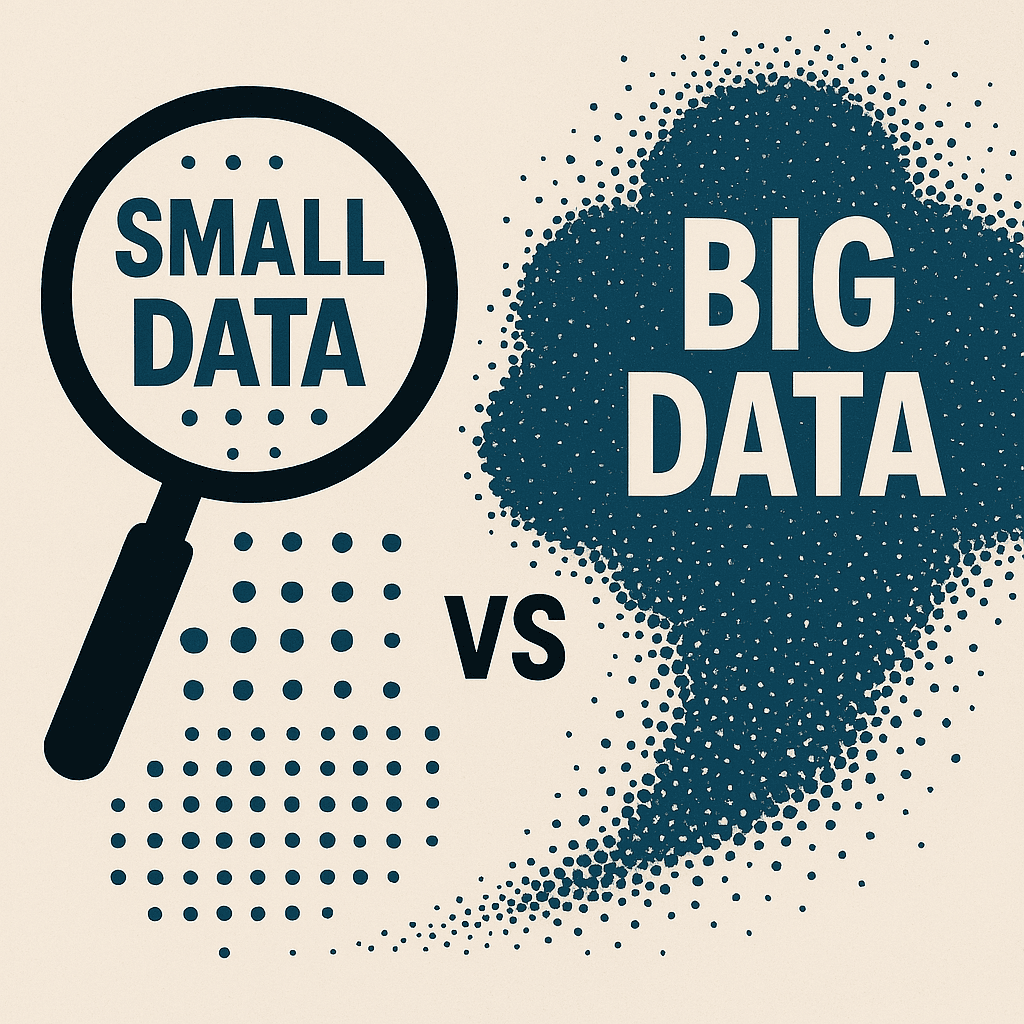
There's a common misconception in the business world: to leverage Artificial Intelligence effectively, you need "Big Data" – enormous, complex datasets requiring massive infrastructure and specialized teams, just like the tech giants. This perception often intimidates Small and Medium Enterprises (SMEs), making AI seem inaccessible or prohibitively expensive.
Let me be clear: **You often don't need petabytes of data to achieve significant AI impact.**
At Fanktank, working with businesses here in the Zurich region and beyond, we frequently find that the most valuable AI applications leverage *smart data*, not necessarily big data. Many powerful solutions, particularly those involving modern techniques like RAG or fine-tuning, can deliver impressive results using your existing, focused business information.
Why the "Big Data" Myth Persists
The myth stems partly from how early, large-scale AI models (especially in areas like image recognition or foundational language models) were trained. These required vast amounts of diverse internet data. However, the landscape has evolved significantly ([Dialzara, 2024](https://dialzara.com/blog/fine-tuning-llms-with-small-data-guide/)).
Where "Small" or "Focused" Data Shines with AI
Modern AI techniques allow us to achieve great results with more targeted datasets:
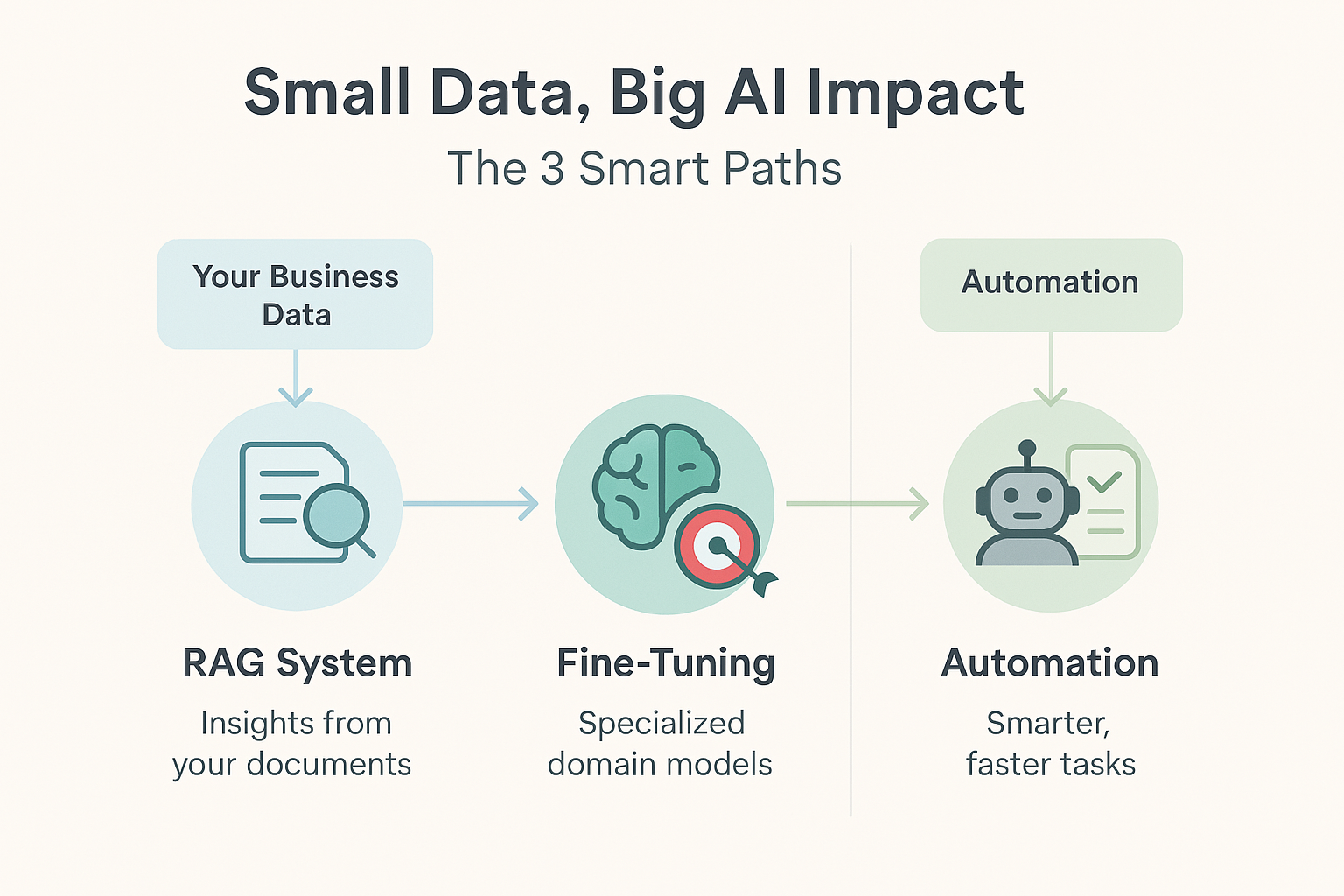
1. **Retrieval-Augmented Generation (RAG):** * **How it works:** RAG systems ([learn more here](/blog/unlock-your-company-knowledge-rag)) primarily use *your own documents* as the knowledge source. The AI retrieves relevant passages from your internal PDFs, manuals, reports, website content, etc., to answer questions. * **Data Needs:** You need a well-organized, reasonably clean corpus of *your relevant business documents*. This could be hundreds or thousands of documents, not necessarily millions or billions of data points. The focus is on the quality and relevance of the content *you already have*. * **Impact:** Can drastically improve internal knowledge access, customer support efficiency, and information retrieval without needing massive external datasets ([Moltz, 2024](https://barrymoltz.com/business/how-retrieval-augmented-generation-rag-can-help-small-businesses-grow/)). We build these [Smart Knowledge Systems](/services/knowledge-systems) for clients using their specific documentation.
2. **Fine-Tuning Large Language Models (LLMs):** * **How it works:** Instead of training a model from scratch, you take a powerful pre-trained LLM (like Llama 3, Mistral, or GPT variants) and further train it on a smaller, high-quality dataset specific to your task or domain. * **Data Needs:** You need a curated dataset of examples relevant to your goal (e.g., examples of customer emails classified by sentiment, technical summaries written in your company style, question-answer pairs for a specific topic). This might be hundreds or a few thousand high-quality examples, not terabytes of raw data. * **Impact:** Adapts powerful models to understand your specific jargon, follow specific instructions, or perform niche tasks far better than the generic model could, using a relatively small amount of targeted data ([Encora, 2024](https://insights.encora.com/insights/fine-tuning-small-language-models-cost-effective-performance-for-business-use-cases), [Dialzara, 2024](https://dialzara.com/blog/fine-tuning-llms-with-small-data-guide/)). This is part of our [Custom AI Development](/services/custom-dev).
3. **Intelligent Automation with Focused Data:** * **How it works:** AI can automate tasks like extracting information from specific document types (invoices, contracts, forms) or classifying customer feedback based on content. * **Data Needs:** Often requires examples of the documents to be processed or labeled examples of the feedback categories. The volume depends on the complexity but is usually manageable within a business context. * **Impact:** Streamlines workflows and extracts value from existing operational data streams ([PYMNTS, 2024](https://www.pymnts.com/artificial-intelligence-2/2024/61percent-of-smbs-that-use-ai-deploy-it-to-automate-daily-tasks/), [ProfileTree, 2024](https://profiletree.com/leveraging-ai-for-smes/)).
Focus on Quality and Relevance, Not Just Volume
The key isn't the sheer size of the data, but rather:
- **Relevance:** Does the data directly relate to the problem you're trying to solve?
- **Quality:** Is the data accurate, clean, and representative?
- **Accessibility:** Can you easily access and process the data?
- **Context:** Is the data well-understood within your business context?
Often, a smaller, high-quality, relevant dataset yields better results for a specific business problem than a massive, noisy, generic dataset ([Encora, 2024](https://insights.encora.com/insights/fine-tuning-small-language-models-cost-effective-performance-for-business-use-cases), [PCG, 2024](https://pcg.io/insights/real-impact-ai-smes-key-numbers/)).
Start Smart with Your Existing Assets
Before assuming you need a "Big Data" initiative, look at the information assets you already possess. Your internal documents, customer interactions, operational data – these often hold untapped potential for AI.
An effective [AI Strategy](/services/consulting) involves identifying high-value problems that can be solved with the data you *have* or can realistically acquire and prepare.
**Don't let the myth of 'Big Data' requirements hold you back from exploring AI. Let's discuss how Fanktank can help you leverage your existing information assets for significant impact.**
[Book a Pragmatic AI Consultation](/contact)
References
- [Moltz, 2024] ["How Retrieval Augmented Generation (RAG) Can Help Small Businesses Grow"](https://barrymoltz.com/business/how-retrieval-augmented-generation-rag-can-help-small-businesses-grow/), Barry Moltz. *(Explains how small businesses can use RAG to turn existing documents into valuable AI resources.)*
- [Dialzara, 2024] ["Fine-Tuning LLMs with Small Data: Guide"](https://dialzara.com/blog/fine-tuning-llms-with-small-data-guide/), Dialzara. *(A practical guide showing how LLMs can be fine-tuned using small but high-quality datasets.)*
- [PYMNTS, 2024] ["61% of Small Businesses Use AI to Automate Daily Tasks"](https://www.pymnts.com/artificial-intelligence-2/2024/61percent-of-smbs-that-use-ai-deploy-it-to-automate-daily-tasks/), PYMNTS. *(Reports high adoption of AI for workflow automation among SMEs.)*
- [Encora, 2024] ["Fine-Tuning Small Language Models"](https://insights.encora.com/insights/fine-tuning-small-language-models-cost-effective-performance-for-business-use-cases), Encora Insights. *(Emphasizes quality and domain relevance over data volume when tuning small models for real-world business tasks.)*
- [ProfileTree, 2024] ["Leveraging AI for SMEs"](https://profiletree.com/leveraging-ai-for-smes/), ProfileTree. *(Outlines how small businesses can use practical AI tools with minimal data overhead.)*
- [PCG, 2024] ["The Real Impact of AI on SMEs"](https://pcg.io/insights/real-impact-ai-smes-key-numbers/), PCG. *(Provides statistics showing the ROI of AI adoption in SMEs.)*
- [Proietti & Magnani, 2024] ["Assessing AI Adoption in SMEs"](https://arxiv.org/abs/2501.08184), arXiv. *(A research-backed framework addressing the challenges and strategies for AI implementation in small businesses.)*