From Concept to Code: The Lifecycle of a Fanktank Custom AI Project
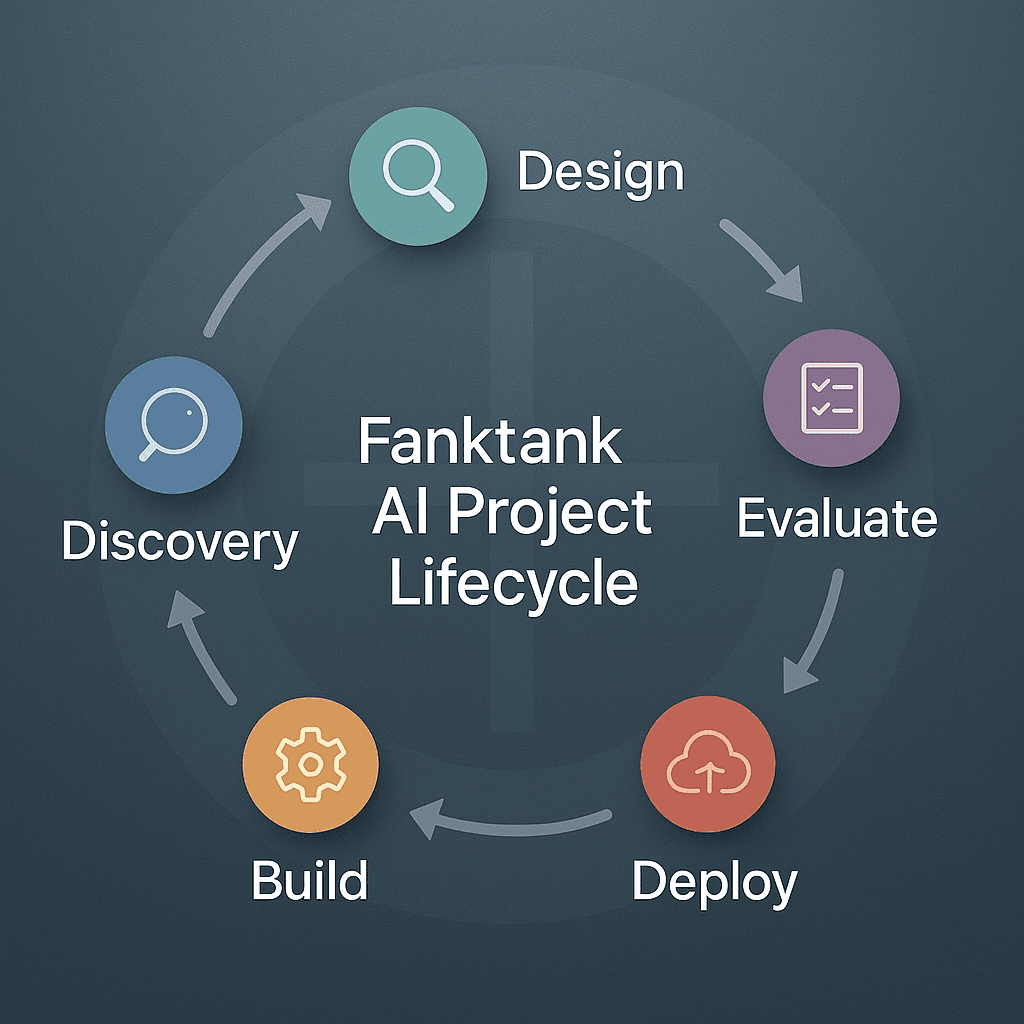
Building a custom Artificial Intelligence solution isn't like installing off-the-shelf software. It's a collaborative journey that transforms a specific business challenge into a working, intelligent system tailored precisely to your needs. Many potential clients ask us: "What does building a custom AI project actually involve?"
At Fanktank, we combine deep AI expertise with a pragmatic, agile approach, refined with Swiss precision. We believe transparency and collaboration are key. Here’s a look at the typical lifecycle of a [Custom AI Development](/services/custom-dev) project with us ([DataScience-PM, 2024](https://www.datascience-pm.com/ai-lifecycle/)):
Phase 1: Discovery & Definition – Understanding Your World
- **Goal:** To deeply understand your business challenge, objectives, existing processes, data landscape, and success criteria.
- **Activities:**
- **Initial Consultation:** A free, no-obligation chat ([Book yours here](/contact)) to discuss your vision and see if we're a good fit.
- **Stakeholder Workshops:** Engaging with your team (users, domain experts, IT) to gather requirements, identify pain points, and map out the desired workflow.
- **Feasibility Assessment:** Analyzing technical feasibility, data availability and quality, potential risks, and estimated ROI ([DataCamp, 2024](https://www.datacamp.com/blog/ai-project-cycle)).
- **Problem Framing:** Clearly defining the *exact* problem the AI will solve and the metrics for success.
- **Outcome:** A clear understanding of the project scope, objectives, potential value, and high-level requirements. A decision point on whether to proceed.
Phase 2: Solution Design & Architecture – Charting the Course
- **Goal:** To design the optimal technical approach for solving the defined problem.
- **Activities:**
- **Technology Selection:** Choosing the right AI techniques (e.g., specific LLM, fine-tuning approach, classical ML algorithm, RAG components), frameworks (like LangChain), databases (vector DBs, SQL), and deployment environment (cloud, on-premise).
- **System Architecture:** Designing how the AI components will integrate with your existing systems and data sources. Planning APIs and data flows.
- **Data Strategy:** Defining data pre-processing steps, feature engineering (if needed), and data security protocols aligned with FADP/GDPR ([Spaceo, 2024](https://www.spaceo.ai/blog/ai-software-development/), [GDPRLocal, 2024](https://gdprlocal.com/how-to-align-ai-with-gdpr-a-compliance-strategy/)).
- **Evaluation Plan:** Detailing how the AI's performance will be measured against the success metrics defined in Phase 1.
- **Proposal & Roadmap:** Presenting a detailed proposal outlining the architecture, deliverables, timeline, and investment.
- **Outcome:** A technical blueprint for the AI solution and a clear project plan.
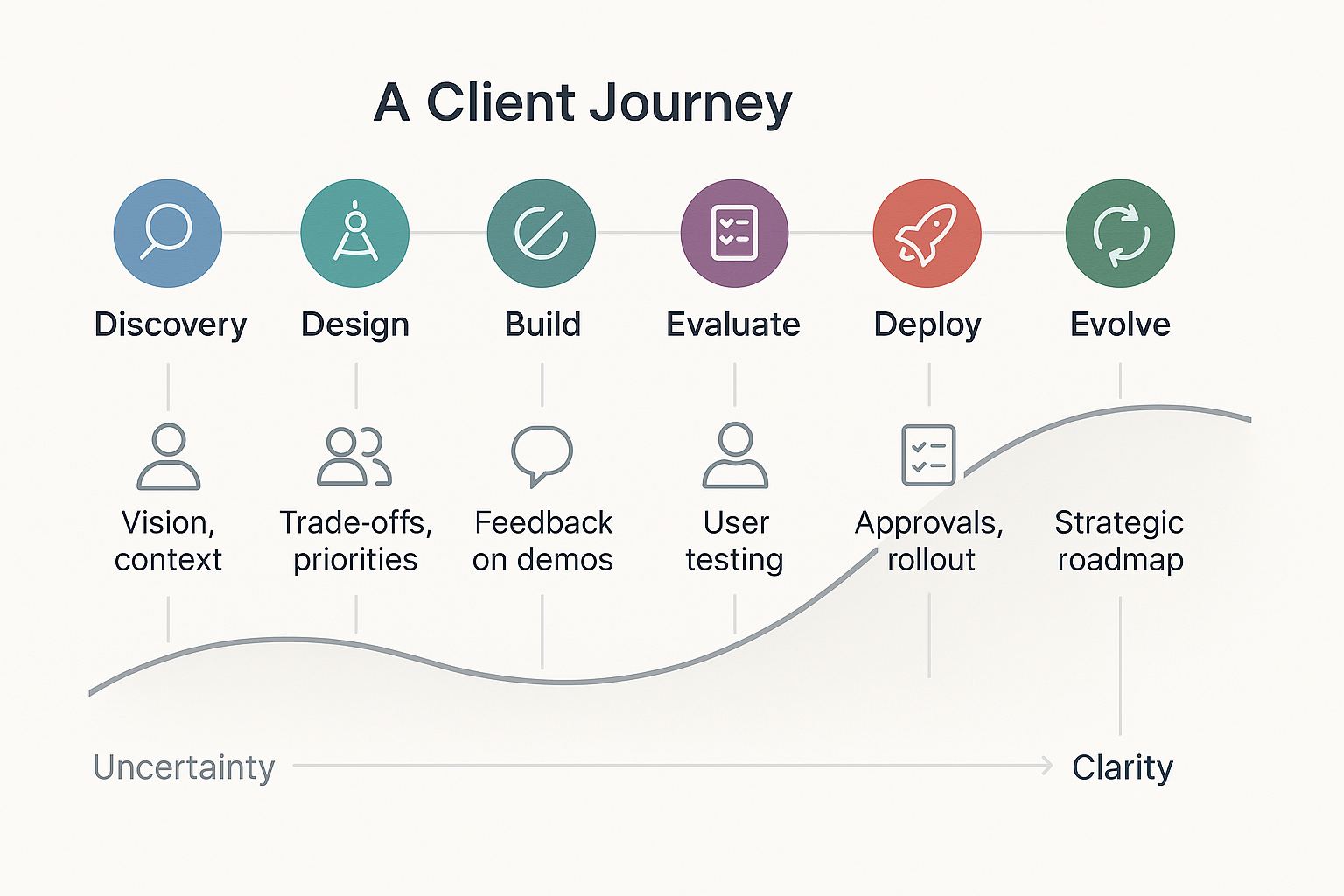
Phase 3: Iterative Development & Training – Building Incrementally
- **Goal:** To build, train, and refine the AI solution in manageable sprints.
- **Activities:**
- **Environment Setup:** Configuring development, testing, and (eventually) production environments.
- **Data Preparation:** Implementing the data pre-processing and cleaning pipelines.
- **Model Development/Fine-tuning:** Writing code, training or fine-tuning models, developing core AI logic.
- **Integration:** Connecting AI components with data sources and other systems.
- **Regular Check-ins & Demos:** Frequent communication and demonstrations of progress to ensure alignment and gather feedback early. We favour agility here ([IBM, 2024](https://www.ibm.com/blog/ai-model-lifecycle-management-build-phase/)).
- **Outcome:** Working increments of the AI solution, tested and validated against requirements.
Phase 4: Evaluation & Refinement – Ensuring Performance
- **Goal:** To rigorously test the AI solution against the defined metrics and refine based on results.
- **Activities:**
- **Quantitative Testing:** Measuring performance using the evaluation plan (e.g., accuracy, precision, recall, latency, cost per inference).
- **Qualitative Testing:** User Acceptance Testing (UAT) with stakeholders to assess usability and real-world effectiveness.
- **Bias & Fairness Checks:** Assessing the model for unintended biases (where applicable).
- **Iteration:** Refining the model, prompts, or data processing based on evaluation results ([Turing Institute, 2024](https://aiethics.turing.ac.uk/modules/introduction/?modulepage=6)).
- **Outcome:** A validated AI solution that meets the agreed-upon performance criteria.
Phase 5: Deployment & Handover – Going Live
- **Goal:** To integrate the AI solution into your live operational environment.
- **Activities:**
- **Deployment:** Deploying the model and supporting infrastructure.
- **Final Integration:** Ensuring seamless connection with production systems.
- **Monitoring Setup:** Implementing tools to monitor performance, usage, and potential issues (like data drift).
- **Documentation & Training:** Providing clear documentation and training materials for your team.
- **Handover:** Transitioning operational ownership to your team ([GSA CoE, 2024](https://coe.gsa.gov/coe/ai-guide-for-government/understanding-managing-ai-lifecycle/)).
- **Outcome:** The custom AI solution is live and delivering value.
Phase 6: Ongoing Support & Evolution (Optional)
- **Goal:** To provide continued support and adapt the AI solution as business needs evolve.
- **Activities:** Performance monitoring, model retraining/updates, feature enhancements, ongoing technical support.
- **Outcome:** Sustained value and adaptation of the AI solution over time.
The Fanktank Difference: Precision and Partnership
Throughout this lifecycle, we emphasize clear communication, practical solutions, and meticulous execution – the hallmarks of Swiss reliability applied to the dynamic field of AI. We work *with* you, ensuring the final solution truly addresses your needs.
**Ready to transform a business challenge into a bespoke AI capability? Let’s discuss how our process can bring your concept to code.**
[Start Your Custom AI Journey](/contact)
References
- [DataScience-PM, 2024] ["What is the AI Life Cycle?"](https://www.datascience-pm.com/ai-lifecycle/), DataScience-PM. *(Defines the typical phases of an AI project from problem scoping to deployment.)*
- [DataCamp, 2024] ["AI Project Cycle Explained"](https://www.datacamp.com/blog/ai-project-cycle), DataCamp. *(Covers the importance of discovery, scoping, and ROI analysis early in AI projects.)*
- [Spaceo, 2024] ["AI Software Development Guide"](https://www.spaceo.ai/blog/ai-software-development/), Spaceo. *(Details technical design, architecture, and tool selection strategies for AI solutions.)*
- [GDPRLocal, 2024] ["How to Align AI with GDPR"](https://gdprlocal.com/how-to-align-ai-with-gdpr-a-compliance-strategy/), GDPRLocal. *(Outlines data privacy and governance best practices for compliant AI design.)*
- [IBM, 2024] ["AI Model Lifecycle – Build Phase"](https://www.ibm.com/blog/ai-model-lifecycle-management-build-phase/), IBM. *(Explains best practices for environment setup, model building, and iterative development.)*
- [Turing Institute, 2024] ["AI & Machine Learning Project Lifecycle"](https://aiethics.turing.ac.uk/modules/introduction/?modulepage=6), The Alan Turing Institute. *(Covers evaluation and bias mitigation in ML projects.)*
- [GSA CoE, 2024] ["Understanding and Managing the AI Lifecycle"](https://coe.gsa.gov/coe/ai-guide-for-government/understanding-managing-ai-lifecycle/), U.S. GSA Center of Excellence. *(Provides guidance for AI deployment, handover, and post-launch monitoring.)*